
Even the mention of shame can bring up a desire to avoid talking about it. It is the worst feeling and experience. It is experienced as a constant dull ache radiating throughout our whole body, or as a sudden flash of heat and an intense urge to disappear. It is a self-conscious emotion that focuses inward towards parts that represent our authentic being. In this post, we are going to talk about how shame develops and progresses, and the parts of us that develop to try to avoid experiencing shame, while at the same time increasing our shame in our system. This is why it is a cycle: the more we try to prevent it, the more we add to the shame messages we are carrying.
Where it starts – A bad thing happened to me – the development of an exile part.
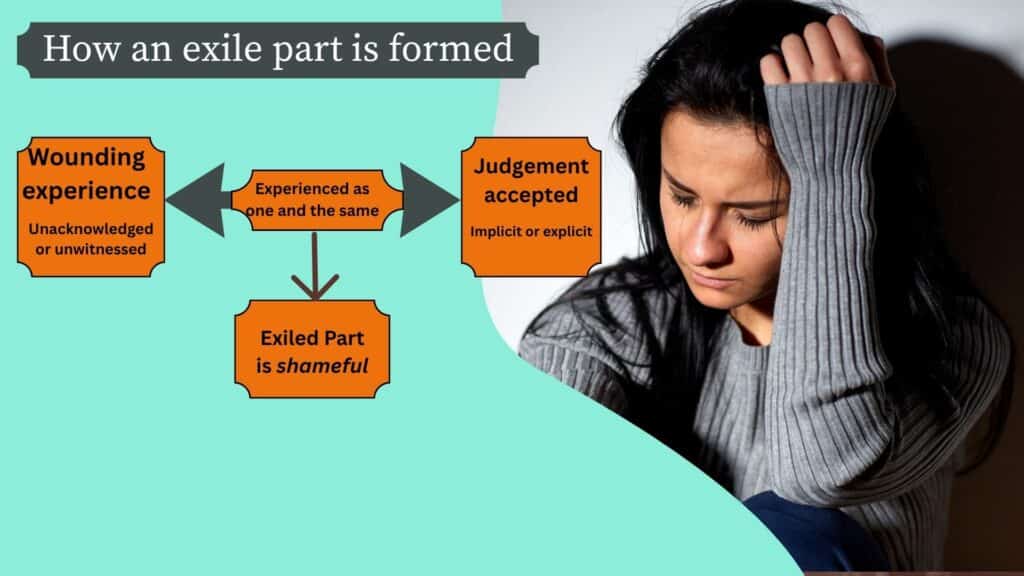
When hurtful things happen in childhood and go unwitnessed and unacknowledged, we simultaneously accept a judgment related to that experience.
Let’s take an example:
When we need our parents, and they are not there or do not respond to our cries, our need for connection, attention, or fear, then their lack of attention is a message that our experience is unwanted or rejected. This message can be implicit (implied by the parent being absent or preoccupied) or explicit ( verbal humiliation about needing comfort or care). This judgement happens at the same time the child has a wounding/overwhelming experience. The unacknowledged experience and the judgement become the same thing that creates the exiled part, full of shame. This leads to fear, hiding and rage. It is important to realise that these are two different things, and that healing involves acknowledging the experience and recognising that the judgement about it is wrong.
Authenticity versus Attachment.
What contributes to the merging of experience and judgement is the choice a child must make between two different needs. To be authentic and to attach to the adults who care for them. Their survival means that the choice for attachment (maintaining immediate relationships) will win out over authenticity (expressing their needs and experience), so the judgement is accepted to maintain the relationship, and the “exile part” has to be disconnected. We are having to disconnect with an essential part of us that has become shameful.
What is Authenticity?
Below are five aspects of what we come into the world with that make up our authenticity and these aspects that get shamed and disconnected from to maintain relationships.
- Vulnerability
Without protection from a parent, a child’s vulnerability becomes dangerous and disconnected. Shaming messages of vulnerability as weakness, bad, dangerous – when there is no protection, we can’t show vulnerability, and it becomes something to. - Nascent reason
Denial of a child’s experience and truth leads to the shame of expressing what is true for them. On the other hand, a parent can reinforce a child’s misconceptions or mistakes, leading to a lack of tolerance for criticism. - Dependence
When a child is cared for, there is no shame or guilt in asking for help. A lack of care shames dependence and causes us to disconnect from when we need others. A child’s natural curiosity and movement into independence can also be shamed when the parent is threatened by their separation. - Appropriate maturity
Being able to act your age. Shame around irresponsibility, feeling overwhelmed, incompetence, and behaviours associated with different ages. - Exuberant energy
Natural energy, excitement, delight, curiosity, movement.
I agree. I am shameful.
So the exile has taken to heart that I am bad because I am ignored. They are ignoring me, and it must be because of me. There is something about me that is unwanted. As adults, we know cognitively that this is not true, but the message has already been received and accepted, and we disconnect from it to protect ourselves from further shame. It is this disconnection that keeps the shame message going. Our adult self, which may understand something different, can not connect with the exile. There is a system of other parts that develop over time to maintain this disconnection.
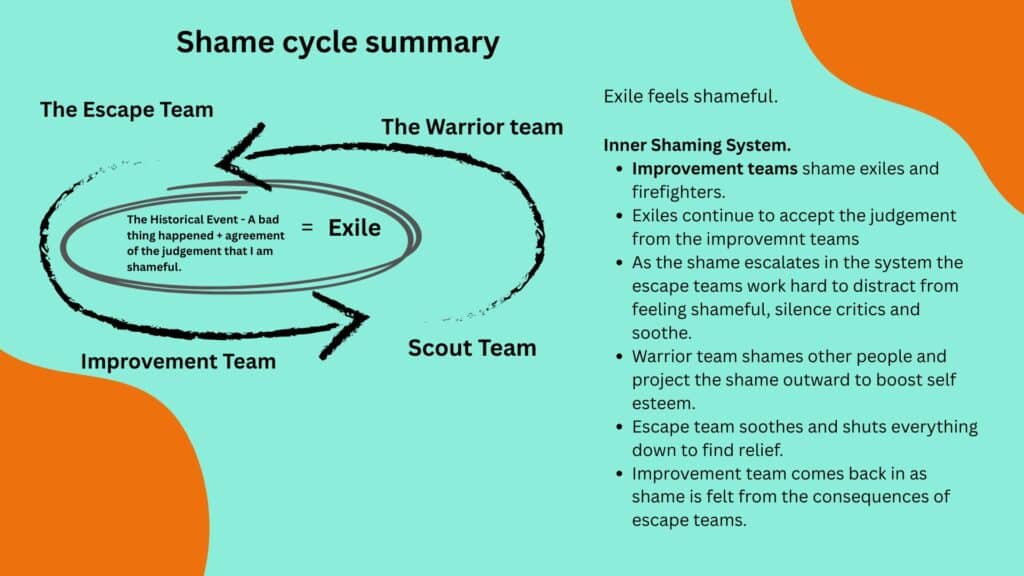
We develop an internal shaming system that aims to protect against shame while also reinforcing the shaming messages.
This system has 4 teams of parts that are connected to the exile. Each team has its own function in relation to shame.
First are the Internal shamers. There are two teams. The improvement team and the scouting team.
Improvement Team
These parts hold the child/exile responsible for being shamed. Their goal is to improve or hide what is shameful. They are focused on changing what is unacceptable into what is acceptable.
- Shaming parts based on external shamers
- Inner critics
- Perfectionist parts
- Being good and working hard parts
- Fixing/solution finding parts.
- Focused on right/wrong, good/bad
- Monitors/censors/analyzer parts
- Self-doubting parts.
Scout Team.
These are the parts that want to prevent it from happening again. Their goal is to anticipate situations or control the exile from being seen. Shame is always on the horizon.
- Vigilant parts.
- Obsessive parts
- Catastrophizing parts
- Conforming parts
- People-pleasing parts
- Comparing parts
- Caretaking parts
Second, there are two relief teams. The warrior team and the escape team.
As the shame within the system builds, these parts seek relief in different ways. The ways they try to protect the system from shame increase shame through the consequences of how they do it.
Warrior team
These parts find relief by passing on the shame like a hot potato. They look outside for where to place the shame. I am not shameful; it is you, not me. This temporarily boosts self-esteem but has relational consequences that bring in more shame.
- Justice-seeking parts
- Judgmental parts
- Self-righteous parts
- Sarcastic parts
- Blaming/defensive parts
- Confronting parts
- Angry parts
Escape Team
These parts focus on finding relief from the onslaught of internal shame and external messages about shame.
- Impulsive parts
- Distracting parts
- Dissociative/numbing parts
- Compulsive/addictive part
- Obsessive-compulsive parts
- Reassurance seeking parts
- Suicidal part
- Withdrawing/isolating parts
- Intellectual/analysing parts
So all these teams have taken to heart the message that something is wrong with them and, in their own way, are attempting to prevent it from happening again. As they do this, they reinforce shame and bring more of it into the system. Over time, there is less and less relief and more conviction that they are unlovable, bad, unwanted, incompetent, a failure, and the only way forward is more and more escape.
The way out of the cycle
There is hope. It is possible to break this cycle, and it can take a long time, but as we become aware of the various parts of our system and how our shame cycle has developed, we can heal and begin to lift the shame from our system. By bringing self-compassion to these parts for how they have attempted to deal with what happened, we can eventually release the judgement we took to heart.
Recovery involves knowing a bad thing happened to me, not because of me.
This kind of healing is often part of trauma counselling, where past experiences, shame, protective patterns, and emotional pain can be explored with care and support.